
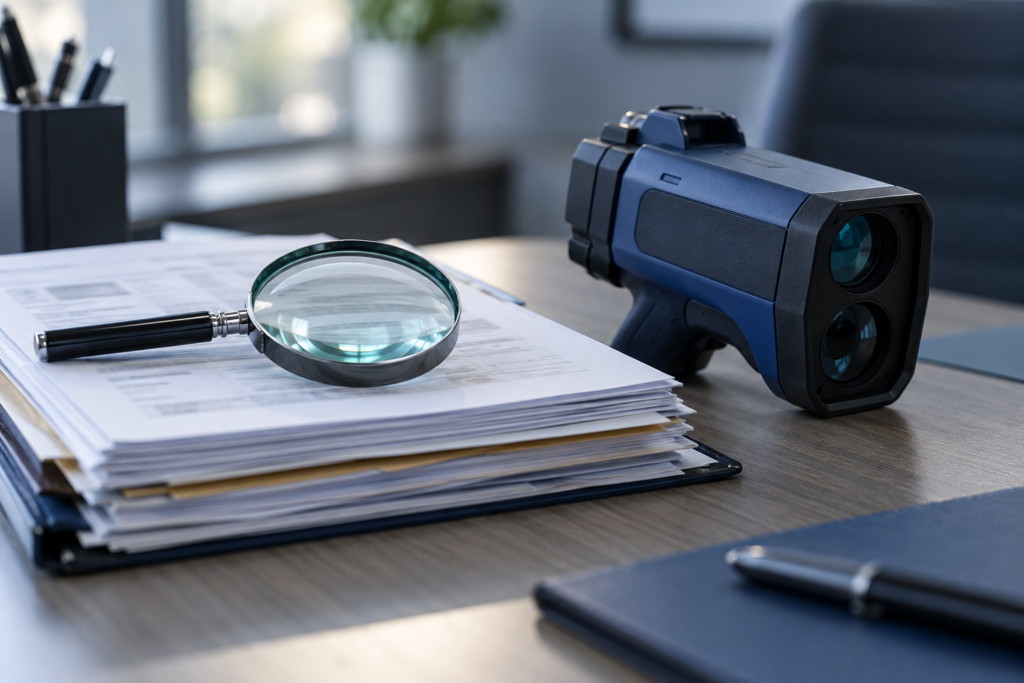
Most drivers who plead not guilty to an Alberta traffic ticket have never set foot in a courtroom for anything. The uncertainty of what actually happens on the day — where to go, what to say, whether the officer even shows up — causes more anxiety than the ticket itself. That uncertainty is also exactly why a lot of drivers who had a real shot at beating their ticket end up pleading guilty at the door instead.
Here’s what the process actually looks like, and where the decisions that matter most get made.
Executive Summary
Most winnable traffic cases in Alberta are decided before anyone enters the courtroom — in the response deadline and in disclosure. This post walks through the path from ticket to trial, what disclosure reveals, what actually happens on the day, and how to prepare depending on the type of ticket you’re facing.
In This Article
The path from ticket to trial
| Stage | What happens | Why it matters |
|---|---|---|
| Response deadline | You enter a not-guilty plea before the date printed on the ticket, generally about 30 days from issue | Missing this deadline typically results in a conviction by default — the case never reaches a courtroom at all |
| First appearance / disclosure request | A date is set, and you (or your representative) can request disclosure — the officer’s notes, radar or laser calibration records, dashcam footage if it exists | Disclosure is where most winnable defences are actually built; the fine print and calibration logs matter more than the story you’d tell a judge |
| Trial date | The Crown or prosecutor presents evidence, the officer may testify, and you or your representative can cross-examine and present your own case | This is a formal proceeding, not a conversation — the rules of evidence apply, and unpreparedness shows immediately |
| Decision | The justice rules based on the evidence presented that day, not on your driving history or explanation of hardship | Sympathy is not a legal defence; procedural and evidentiary gaps are |
What actually gets requested — and why it’s the whole game
Disclosure is the Crown’s evidence: the ticketing officer’s notes, the specific radar or laser device model and its calibration and testing records, and any video that exists. Requesting and reviewing disclosure well before the trial date is standard practice for a reason — it’s where a case gets found to be strong, weak, or somewhere in between, before anyone stands up in front of a justice.
Common things disclosure reveals: a calibration certificate that’s expired or missing, a device operator without current certification on file, notes that don’t match the ticket’s stated facts, or — just as often — a clean, well-documented case where a trial isn’t the right move at all. Knowing which one you’re holding changes the entire strategy.
What actually happens the day of
Traffic court in Alberta runs like any other provincial court proceeding. You (or an authorized representative appearing on your behalf, since Alberta permits both licensed lawyers and specialized agents to represent clients in traffic matters) will be called, the prosecutor presents the Crown’s case, and there’s an opportunity to cross-examine the officer if they testify and to present your own evidence or argument.
Dress and conduct matter more than most drivers expect — this is a real courtroom with a sitting justice, not an informal hearing. Being late, unprepared, or argumentative about the underlying facts (rather than the legal or procedural issues) tends to work against a driver regardless of how strong the underlying case is.
If you don’t show up at all, you can be convicted in your absence, and unwinding a conviction in absence afterward is a much harder, slower process than simply attending or having someone attend for you.
Preparing for trial, segmented by what you’re facing
A speeding ticket based on radar or laser. The device model, its calibration date, and the operator’s certification are the first things to check in disclosure. A gap here is one of the more common, genuinely winnable issues in Alberta speeding matters.
A careless driving or major moving violation. These carry higher fines and more demerit points, and the Crown typically comes prepared with more detailed officer notes. The bar for a strong defence is higher, which makes early disclosure review even more important than for a minor ticket.
A ticket tied to a commercial licence. For Class 1 drivers, a conviction doesn’t just cost demerit points — it can affect employment, safety ratings, and a company’s National Safety Code standing. These cases usually justify professional representation regardless of the fine amount, because the downstream cost dwarfs it.
You’re unsure whether it’s worth fighting at all. Not every ticket should go to trial. Sometimes a negotiated reduction to a lesser, non-moving charge protects your insurance and abstract without the time cost of a full trial — but that option usually has to be raised with the prosecutor before the trial date, not on it.
What we tell people honestly
We don’t put anyone in front of a justice without having already reviewed the disclosure and told them, plainly, what the realistic range of outcomes looks like. No legal service can guarantee a result — what we can guarantee is that you’ll know exactly what you’re walking into before you’re standing in a courtroom for the first time in your life over a traffic ticket.
If you have a trial date coming up and haven’t requested disclosure yet, that’s the first call to make — and the sooner, the more time there is to actually use what it shows. Send us your ticket for a free review at albertaticketdefense.com/contact, or call (403) 805-4212.
This article is general information about Alberta traffic matters and is not legal advice. No outcome can be guaranteed.